Services
Concrete
Concrete Installation Services
Atkins Paving offers professional concrete paving services for residential and commercial projects. Concrete is a strong and reliable material that delivers a clean, long lasting surface ideal for driveways, sidewalks, patios, parking areas, and more.
Concrete is known for its durability and low maintenance. It resists heavy loads, holds up well over time, and maintains its appearance with minimal upkeep. It is an excellent choice for property owners looking for a permanent solution with a smooth and refined finish.
We handle every stage of the process, from site preparation and forming to pouring and finishing. Our crew ensures proper grading, reinforcement, and curing to maximize strength and lifespan.
Whether the project involves a new installation or replacing existing concrete, Atkins Paving delivers precision workmanship and dependable results. We work closely with homeowners, contractors, and business owners to meet design goals, timelines, and budgets.
Our concrete paving services are built to add value, enhance curb appeal, and provide long term performance across a wide range of applications.
Concrete services we install
Concrete driveways
New concrete driveways, driveway replacements, and driveway extensions. Standard finishes include broom, smooth trowel, and exposed aggregate. Every driveway is engineered with the correct thickness, mix, reinforcement, and control joint layout for its intended use.
Sidewalks and walkways
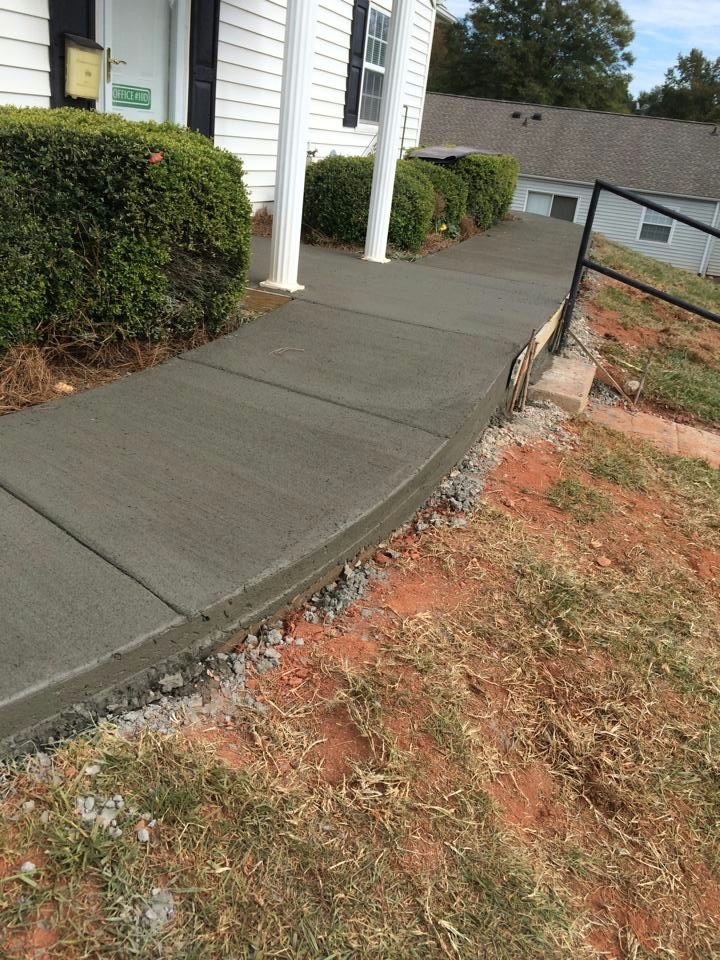
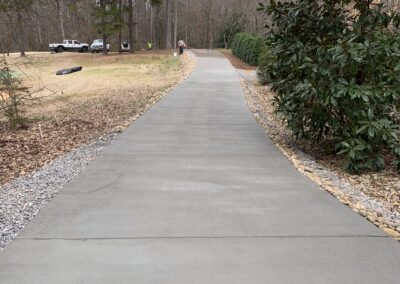
Straight runs, curved walkways, and connecting paths between driveway, front door, patio, and yard. Slopes are set to meet code and shed water away from the home. ADA-compliant designs are available for commercial and multi-family projects.
Patios and slabs
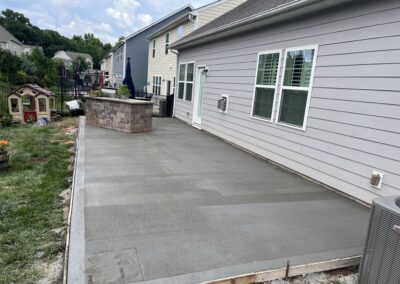
Backyard patios, grill pads, hot tub pads, and equipment slabs. Sizing, thickness, and reinforcement are matched to the load and use, whether that is a lounge patio, a heavy grill setup, or an outdoor kitchen.
Aprons, curbs, and transitions
Concrete aprons where asphalt driveways meet the street or a garage, curb sections, and transition slabs between grade changes. These small pours protect the more expensive pavement on either side of them.
Commercial concrete flatwork
Loading dock pads, dumpster pads, drive-thru approaches, ADA ramps, and light commercial parking sections. Heavy vehicle traffic and static heavy loads punch through undersized asphalt. Concrete in those specific areas extends the life of the entire lot.
Our concrete process
1. Subgrade preparation
We excavate to depth, remove weak or organic soil, place and compact a stone base, and set the finished grade to shed water. Skipping compaction on the subgrade is the top reason concrete driveways settle and crack out of pattern.
2. Forming and reinforcement
Formwork is set to the design elevations. Steel reinforcement, either welded wire mesh or rebar depending on the project, is placed and chaired so it sits within the slab rather than on the ground.
3. Pour, screed, and finish
We schedule concrete deliveries against weather so the pour happens under conditions that produce the strongest surface. The mix is placed, screeded to grade, floated, and finished to the specified texture. Control joints are cut at engineered spacing.
4. Curing and sealing
Fresh concrete needs moisture and time. We apply cure and seal or wet cure per the mix requirements, protect the surface during the first days, and give you a plain-language schedule for foot traffic, vehicles, and full strength. A penetrating sealer on the finished surface is optional but recommended.
Concrete versus asphalt: how we help you choose
Both materials do the job well when they are installed correctly. Concrete costs more up front, lasts longer, resists oil staining once sealed, and gives a lighter appearance. Asphalt costs less, is faster to install, is easier and cheaper to repair or resurface, and gives a darker, more traditional look. If curb appeal, longevity, and one-time investment matter most, concrete tends to win. If lower up-front cost and easy long-term maintenance matter most, asphalt tends to win. We install both and will recommend the one that actually fits your site, your use, and your budget.
Frequently Asked Questions
How long does a concrete driveway last?+
A properly installed concrete driveway in the Carolinas typically lasts 30 to 40 years or more. Longevity depends on subgrade preparation, mix design, reinforcement, control joint placement, and how well the surface is sealed against water and de-icers. Concrete outlasts asphalt on the surface, but repairs cost more when they are needed.
How thick should a residential concrete driveway be?+
For standard passenger vehicles we install 4 inches of reinforced concrete over a compacted stone base. For driveways that see heavier loads such as RVs, boats, or work trucks, we recommend 5 to 6 inches with additional reinforcement. Apron sections at the street and sections under wheel paths are often thickened.
When can I drive on new concrete?+
Foot traffic is safe after 24 to 48 hours. Passenger vehicles can typically use a residential concrete driveway after 7 days. Heavy vehicles, trailers, and RVs should wait 28 days for the concrete to reach full design strength. Rushing these windows leads to cracks that no repair can fully hide.
Why does concrete crack, and can it be prevented?+
All concrete cracks somewhere. The goal is to control where. We place control joints at engineered spacing so the inevitable shrinkage cracks form inside the joint instead of at random. Combined with proper subgrade, correct mix, and adequate curing, this keeps the visible surface clean for decades.
Should I choose concrete or asphalt?+
Concrete has a longer service life, a lighter appearance, and lower routine maintenance. Asphalt has a lower install cost, is easier to repair and resurface, and is faster to return to service. Climate, budget, expected life in the home, and design preferences all factor in. We are happy to talk through both and quote either.
Do you sealcoat or seal concrete?+
We do not apply asphalt sealcoat to concrete, but we can seal concrete surfaces with a penetrating concrete sealer to protect against water, de-icers, and staining. Sealing a concrete driveway every 3 to 5 years significantly extends the life of the surface finish.